
The Ferry Is Free
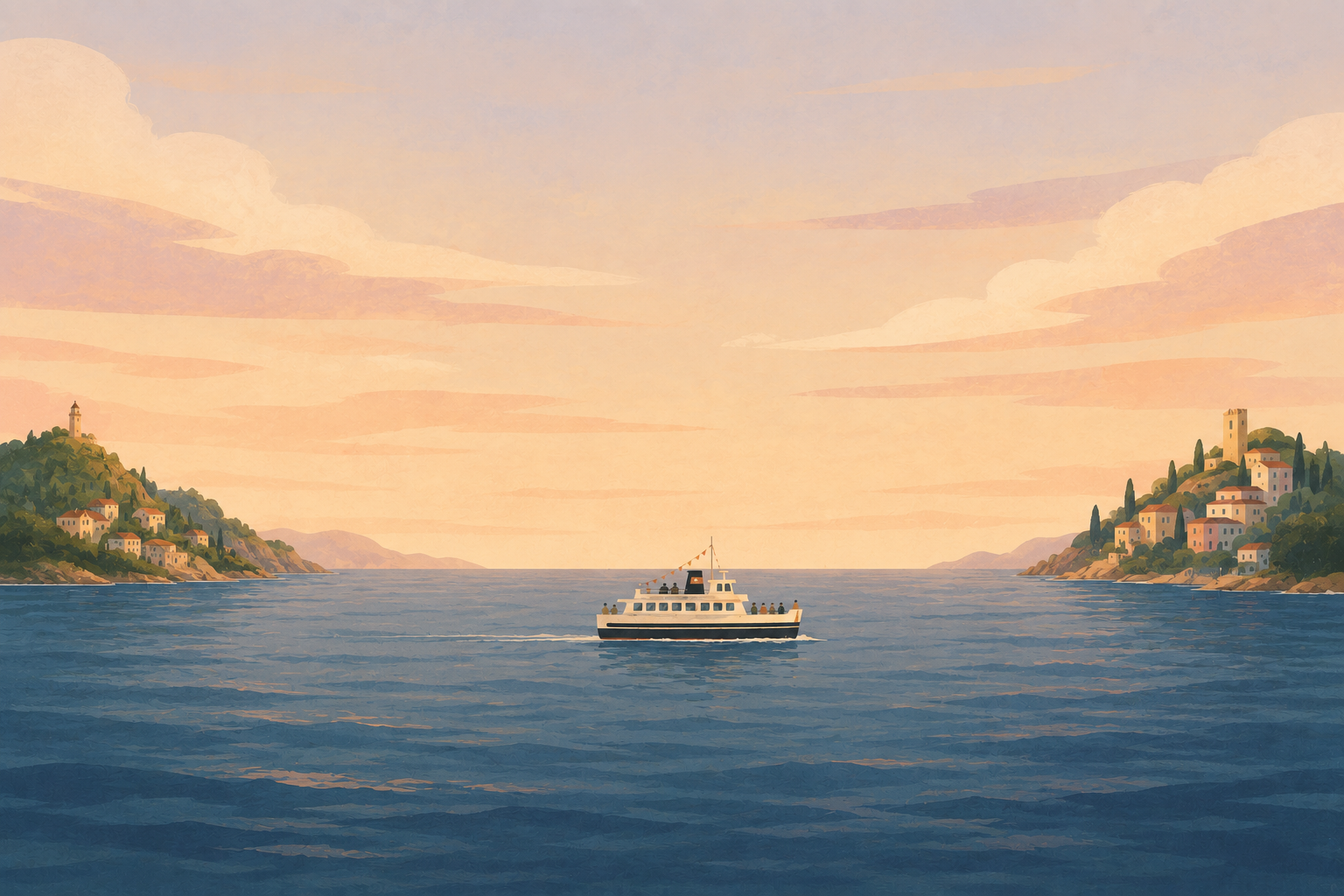
There are two islands close enough that on a clear morning you can see the other one’s rooftops from your own beach.
The eastern one is Windward. The western one is Leeward. Which is named correctly depends upon the weather of the day, though almost nobody on either island thinks about that anymore. The names have been the names for a long time.
It’s 1980, and both islands have a newspaper. And the papers are good.
Windward’s paper covers the sewage bond honestly. When it gets a number wrong it prints a correction, and readers write in to complain, and the reporter feels bad about it. Leeward’s paper is the same. Its city desk broke the harbor contracting scandal, and two councilmen went to prison over it. The people who work at these papers are not liars. Most of them got into this because they believed something about the public good. A surprising number still do.
The trouble is on the foreign desk.
Each paper keeps one reporter, sometimes two, whose job is to explain the neighbors. That desk operates under different pressures than the rest of the building. Nobody on Windward writes in to complain that a story about Leeward got the details wrong, because nobody on Windward can check.
What the foreign desks report
Windward’s foreign desk reports that Leeward is cruel.
Leeward’s foreign desk reports that Windward is stupid.
Neither desk fabricates. Both islands are ordinary places with ordinary populations, which means both produce cruelty and stupidity in roughly the volumes you would expect from any few hundred thousand human beings.
But there’s always material. The foreign desks’ craft is not so much reporting, but selection, and both desks are extremely good at it.
Windward’s readers know exactly what Leeward thinks. They have read about it for years. They have simply read about it in a register that makes Leeward’s every position sound like something a decent person arrives at only through malice and hatred.
And Leeward’s readers know what Windward thinks. They have read about it in a register that makes Windward’s positions sound like the output of a population that has been had.
These are different errors. A Windwarder who somehow read a year of Leeward’s coverage would come away thinking Windward is dim. A Leewarder who read a year of Windward’s would come away thinking Leeward is vicious.
The two islands have arrived at different ways of dismissing each other. The islanders feel great that they’re on the best island.
Ana rides the ferry
Ana Sirre has covered Leeward for Windward’s paper for twelve years.
She rides the ferry. Almost nobody does. It runs twice a day, 7:15 in the morning and 4:40 in the afternoon. It is subsidized in both directions, and has been free for as long as anyone can remember. There is no wall. There are no guards. There is no list, no permit, no border officer who asks you your business. Forty minutes on a boat that seats two hundred, but these days, it’s down to a couple dozen on most sailings.
Nobody is trapped on either island. Every one of these people could stand on the other one by dinner, but does not want to.
Ana wants to. She has friends over there. She knows which cafe in the Leeward harbor district has the good coffee and which one has the good gossip, and she knows the difference between what Leeward’s loudest people say and what a Leeward plumber says while he is fixing your sink and does not know you are a reporter. Her copy reflects all of that. It is careful, specific, full of the kind of detail you only get by being present.
Her copy also does not do very well.
Tomas does not ride the ferry
Tomas Vell joined the foreign desk four years ago. He has crossed twice, both times for a wedding.
He works from Leeward’s public feeds, its council recordings, its loudest accounts, and the reliable daily harvest of Leewarders saying appalling things where anyone can hear them. It is real material. He is not making it up. He assembles it into pieces that run under headlines like What Leeward Really Thinks Of Us, and those pieces do four to six times Ana’s numbers, consistently, for years. Windward’s residents love Tomas and often buy him beers at the local pub.
Halloran, the editor, is a tired man with a budget. One afternoon, after Ana pushed, he finally turned his monitor around so she could see the dashboard herself, and the two of them looked at it for a while without saying anything. Her Tuesday piece on the Leeward pension fight, three weeks of work: 1,100 readers. Tomas’s Thursday roundup: 62,000, and climbing while they watched.
“I’m not killing your stuff,” Halloran said. “I’ve never killed your stuff.”
That was true. He never has.
Nobody is censoring anybody. There is a free ferry nobody boards, and an accurate correspondent nobody reads, and both of those trace back to the readers who would tell you sincerely that all they want is the truth.
The story that got killed
In her thirteenth year decided to do something new. Ana wrote about Windward.
Her own island, her own people, using exactly the method she had used on Leeward for twelve years: the clinical distance, the outside eye, the refusal to grant that anyone’s stated reasons were their real ones, the careful harvest of the worst three minutes of the council meeting. She invented nothing. Every fact in it was checkable and every one of them checked.
Halloran killed it.
He went through it line by line looking for an error he could point at, did not find one, and killed it anyway. What he told her was this:
“Nobody can read this. It reads like it was written by somebody who hates us.”
He was right. That was the method. He had been running that method on the front page every Thursday for four years and had never once heard it described that way, because it had never before been pointed at anybody he knew.
Which island is which
You decided several paragraphs ago.
You have probably also decided you are Ana. Everyone puts themselves on the ferry, one of the dozen in a two-hundred-seat boat, crossing regularly, seeing clearly, faintly exasperated with the other hundred and ninety empty seats.
If you were on the ferry, you would know the price of coffee in the other harbor. You would have a name, a specific person over there, someone you would call if their house burned down. You would be able to state their strongest argument in a form they would recognize and accept, with no qualifier attached, without the small internal wink that lets you say it while everyone knows you do not mean it.
Most of us cannot do that. Most of us have read years of accurate, carefully sourced reporting about how the neighbors are cruel, or how the neighbors are stupid, and have mistaken the weight of it for having been there.
The ferry leaves at 7:15.