5 Ways to Turn Your Presentation into a Conversation

If you’ve ever stood at the front of a room or a Zoom call and felt the collective weight of twenty “polite nods” hitting you, you know exactly what I’m talking about. You’re doing everything “right.” Your slides look great and your research is solid.
But as you look out at the audience, you realize you aren’t actually presenting to them, you’re performing at them. They are passive observers, watching you struggle through a monologue while they mentally check their emails or plan their lunch.
Make it Interactive
The most impactful presenters aren’t just great orators; they are masters of engagement. They don’t just deliver information; they create a dialogue, even if it’s not immediately verbal.
The goal isn’t just to “interact”—it’s to transform your presentation from a one-way lecture into a two-way conversation. Here are five proven ways to break the “monologue barrier” and actually involve your audience.
1. The Pattern Interrupt (The Purposeful Icebreaker)
Most presentations start with a predictable, low-energy sequence: “Hi, I’m [Name], and today I’m going to talk about [Topic].”
By the time you get to your third slide, half the room has already checked out. They’ve categorized you as “the person talking” and their brain has switched to “autopilot.”
The Tactic: Start with a pattern interrupt. Instead of an introduction, start with a question that demands a response. It could be a quick pulse check (“How many of you have struggled with X this week?”) or a provocative question (“What is the one thing that would make this topic irrelevant to your job?”).
The Result: You force the audience to switch from “passive observer” to “active participant” in the first 60 seconds. You aren’t just announcing a topic; you’re establishing that their input matters.
2. The Mid-Point Pulse (The “Comprehension Check”)
We’ve all been there: you reach the halfway point of a deep-dive technical presentation, you look up, and you see a sea of glazed eyes. You don’t know if they are following you, or if they’ve completely lost the thread.
The Tactic: Don’t guess. Know. Use a “Mid-Point Pulse.” After you’ve covered a complex concept or a heavy data set, pause. Ask a quick comprehension question.
The Result: This serves as a “micro-exit ticket.” It gives you a real-time signal to either move forward or slow down. It also tells the audience: “Pay attention, because I’m going to ask you something.”
3. The Fork in the Road (Collaborative Roadmapping)
One of the fastest ways to lose an audience is to take them on a journey they didn’t ask for. If you present a rigid, 45-minute linear path, the audience is just along for the ride.
The Tactic: Give them a sense of agency. When you reach a crossroads in your presentation, offer the room a choice. “We can dive deeper into the technical implementation right now, or we can look at the business ROI first. Which would be more useful for this group?”
The Result: When the audience helps decide the direction, they become co-creators of the presentation. They aren’t just watching a slideshow; they are participating in a workshop.
4. The Truth Serum (The Power of Anonymity)
In a professional setting, people are often too “polite” to tell you the truth. They won’t tell you that your proposed solution sounds expensive, or that they don’t understand your main premise, or that they are skeptical of your conclusions.
The Tactic: Use anonymity to surface the “elephant in the room.” Ask a question that allows for honest, unvarnished feedback. “What is the biggest reason this plan might fail in your department?” or “On a scale of 1-10, how confident are you that we can hit this deadline?”
The Result: You get the real data. You move past “performative agreement” and into the kind of honest feedback that actually drives decisions.
5. The Democracy of Questions (The Structured Q&A)
The traditional Q&A is often an awkward dance. You ask, “Any questions?” and you’re met with a heavy, uncomfortable silence. Or, one extrovert dominates the room with a ten-minute tangent that has nothing to do with your topic.
The Tactic: Move away from the “hand-raising” model. Use a method that allows the audience to submit questions and—more importantly—to upvote the ones they want answered most.
The Result: You avoid the awkward silence and the “hijacked” Q&A. You ensure that you spend your time answering the questions that are most relevant to the entire room, not just the person with the loudest voice.
Add Interactivity with PollQR.com
This is exactly why I built PollQR.com.
It’s a way to execute these five strategies.
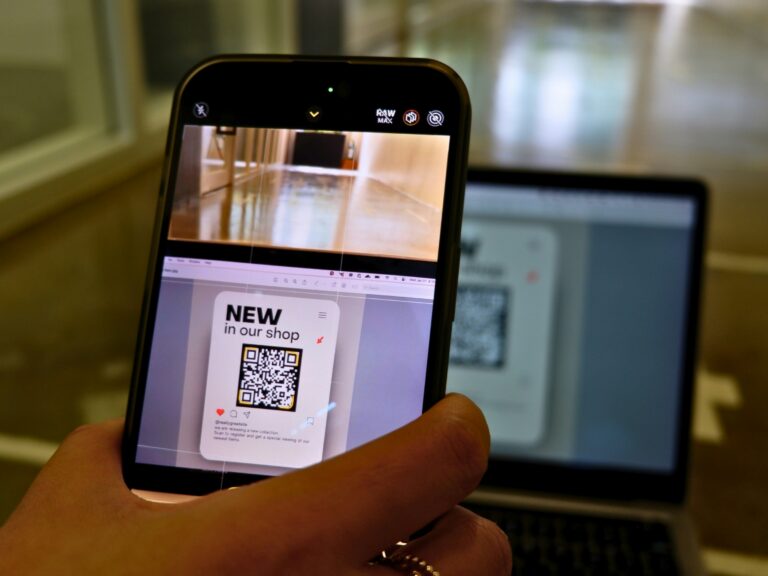
With PollQR, you don’t need a presentation add-in. You don’t need an install. You just generate a QR code, drop it onto your slide, and you’re done. Your audience scans it with their phone’s camera—something they already know how to do—and they are instantly part of the conversation. (Those with laptops can go to PollQR.com and enter your “channel” to participate in the poll.)
No logins, no apps, no friction. Just engagement.
Your Next Step
You don’t have to overhaul your entire presentation style overnight. In fact, you shouldn’t.
Next time you prepare a deck, pick just one of these five methods. Try one pattern interrupt, or one mid-point pulse. See how the energy in the room shifts.
You’ll quickly find that when you stop talking at people, they actually start listening.
Ready to make it easy? Head over to PollQR.com and create your first frictionless poll today.