Event Organizers: Run Competitions Easily with PollQR.
All-in-one voting system for tradeshows, hackathons, cooking competitions and state fairs
At PollQR, I recently received an inquiry from an event organizer who is pulling together a “science fair” competition of sorts at an upcoming international tradeshow. He asked if it would be possible to use PollQR to generate a QR code per tradeshow presenter booth, with simple audience rating and feedback, and also aggregate a Leaderboard of sorts to see who’s ahead and who the audience winner is.
Great use-case!
This is now live at PollQR.com, and called “Competitions.” It’s a great fit for hackathons, state fairs, tradeshows, chili cook-offs, art & science fairs, and more.
Put the Clipboard Away
If you’ve ever run a judged event, you probably know how the afternoon goes. You and the judges walk around with a clipboard. Or maybe paper ballots end up in a box somewhere. Then, around four o’clock, a few volunteers disappear into a back room to add everything up while everyone else waits for the awards.
Maybe someone enters a number wrong. Several ballots are missing a name. And it all takes a long time.
Meanwhile, several hundred people may have walked past every entry and formed an opinion. But there’s no easy way to capture any of that. A better approach: Competitions in PollQR.
Note that you will need either a cellphone connection or wifi, but most venues have them. PollQR doesn’t put any friction on the voter — they don’t have to download any app or create any account.
How it works
You’re the event organizer. You use PollQR’s poll designer to build out the questions you want. You then duplicate it for as many booths as there are, and group them into a “Competition.”
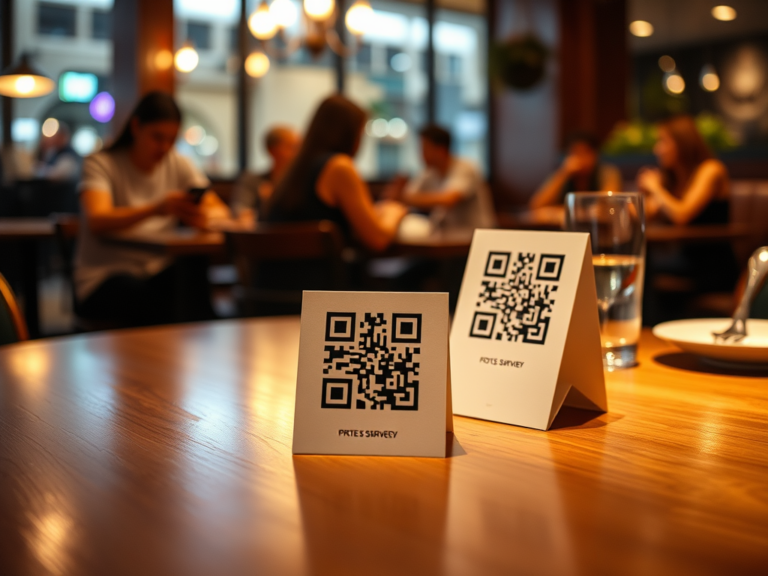
Each competitor gets its own QR code and scoring form. You print the codes, put one at each table or booth, and open voting.
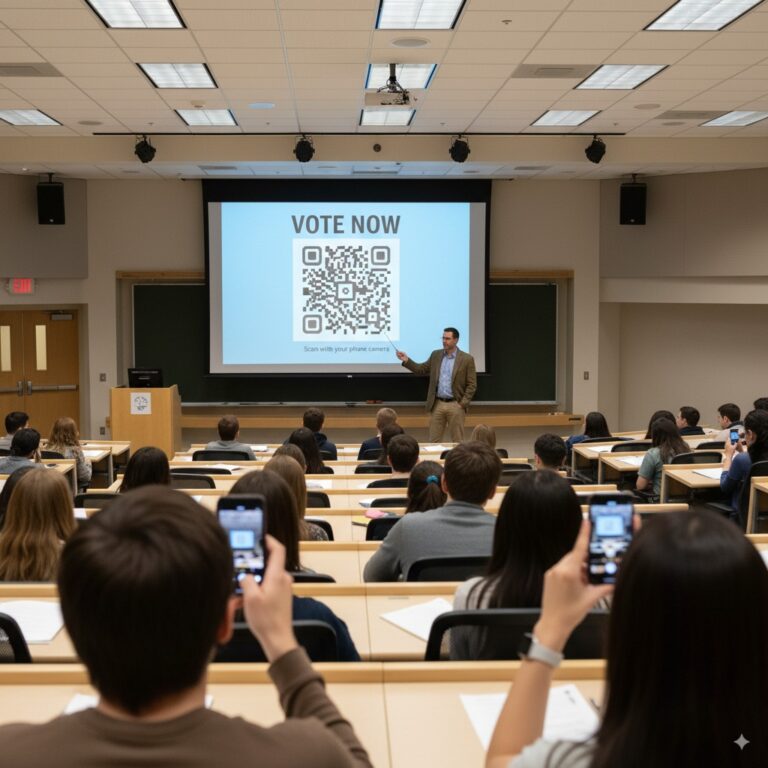
Visitors scan the code (for instance giving the entry a 1–5 score on up to five criteria), and they move on. It takes maybe 15 seconds per booth. Mobile friendly forms. No app, account or email address is required. No database wiring; we take care of all that.
The scores all go into a private leaderboard that updates as votes come in. Voters don’t see the totals until you’re ready to reveal.
It’ll work great for science fairs, hackathons, demo days, pitch contests, art shows, talent shows, conference booth competitions, and BBQ and chili cook-offs.
Visitors See Which Booths They’ve Missed
Visitors at the competition can see which booths they’ve missed, so you can get better coverage.
What do you do about people voting twice?
The obvious solution is to try to identify a device and block it from voting twice. You might think IP address would be the way to go. But IP addresses don’t work very well at conferences. You can have hundreds of phones re-sharing the same Wi-Fi address. If you block that address after the first vote, the second person standing at a booth gets told they’ve already voted.
Browser fingerprinting has its own problems. Two people with the same phone model, OS, and browser can look remarkably similar. At a tech conference, that’s not some theoretical edge case. There could be a lot of them.
So PollQR takes a simpler approach: once a device votes for an entry, that device can’t vote for that same entry again.
Should a quiet table beat a busy one?
There’s another problem PollQR addresses. Imagine one contestant gets six votes, all of them generous, and ends up with an average of 4.8. And another entry gets 200 votes, but averages 4.4.
The first one technically wins.
But maybe nobody visited the first table.
So the leaderboard shows the vote count alongside the score, and the event organizer can set a minimum number of votes. Entries below that threshold are marked provisional.
It’s a pretty simple thing, but it gives the jury some context when they look at the rankings.
There are more sophisticated ways to handle this. You could pull low-volume scores toward the overall event average using a Bayesian approach, for example. I may eventually do something like that. For now, I like the simpler solution. Show people the data and let the jury use some judgment.
Pricing
Trade show and State fair competitions are a big deal, and you’ll want a platform with robust uptime and high througput.
Smaller events might be a high school science fair or hackathon. For PollQR, it’s priced as a per-event service at two levels — up to 10 competitors and 11 or more. You can create the competition, add the entries, print the QR codes, test everything on your own phone; purchase happens when you’re ready to open voting.
If you’re running one
The details are on the Competitions page. If you run a science fair, demo day, art show, hackathon, or any other event where a room full of people is forming opinions about a bunch of entries, I’d be interested in hearing how it works for you.
The interesting problems don’t show up when I’m sitting at my desk testing three fake entries.
They show up when there are 400 people in a room, the Wi-Fi is overloaded, somebody printed the wrong QR code, and the awards ceremony starts in 20 minutes.
And if you’re the person who’s been carrying the clipboard around all afternoon: Relax. You can probably put it down.
Give it a try at PollQR.com.