
Flip 7 Card Game: Optimal Strategies

Last week, I was in Colorado with old friends. The five of us met thirty seven years ago this week, on move-in day at business school, and have been friends ever since.
Two are superb golfers. One is learning guitar. Another’s a business school lecturer on strategy. All are pretty darned smart.
We hiked and went fly-fishing. One evening, we played “Flip 7,” an easy-to-learn card game with rules explained here. Super fun game, suitable for ages 8+; lots of room for talking. Flip 7 is a game that feels about 65% luck and 35% strategy.
Simplified Summary of Flip 7 Card Game Rules
Flip 7 is a push-your-luck game. If it had a Hollywood log-line, it would be “Blackjack meets Uno.”
The deck
There are ninety-four cards. Seventy-nine of them are numbers, and with the exception of the 0 card, the count matches the face value: one 0, one 1, two 2s, three 3s, all the way up to twelve 12s. You’re trying to get the highest point total for your hand before you get a duplicate card (i.e., a “bust”, making your hand worthless for the round.)
The deck’s configuration is what makes the game interesting: the card which helps you most (e.g., a 12) is also the card most likely to “bust” you next flip. This is very important — focus on the fact that there are twelve 12’s, one 1 card, etc. That materially changes the odds of what you’re drawing each time by taking a “hit.” You have no chance of ever duplicating a 1 or a 0 card, so those are freebies (and flipping 7 such cards gets you an extra 15 point bonus.) But if you drew a 12, there lurk eleven other 12 cards if you draw one.
There are also six modifier cards: +2, +4, +6, +8, +10, and a x2. These modify your final score but do not count toward your number of cards “flipped.”
There are nine action cards: three Freeze, three Flip Three, three Second Chance. The player receiving these must play the “Freeze” and “Flip Three” cards before the next card is dealt, and they can do so by assigning this card to any currently active player in the round, including themselves.
Your score is sum(numbers) x (2 if you hold x2) + sum(pluses) + 15 for a Flip 7.
When applying the modifier card (if you end up with one), the order matters. That is, a 5 and a 7 with a x2 and a +10 is 34, not 44. The x2 doubles the numbers only. (We didn’t play by this rule however.)
There’s a dealer each round, and, like Blackjack, a player (including the dealer) chooses in their turn whether to “hit” or “freeze” (stay.) The big catch is that if you draw the same number twice in your hand before you’ve “frozen” your hand, you bust — earning zero points that round. There are also score modifier cards, like +10, x2, etc., which apply to any non-busted hand at the end of a round. The deal is passed to the left after each round.
I got curious about the optimal (or near-optimal) strategy for this game, so I pulled up Visual Studio Code and Claude and burned some tokens.
Optimal “Flip 7” Strategies
The whole game is one question, asked over and over: hit or stay?
So, what’s the answer? When should you hit, and when should you stay?
I built a simple game engine in Python with the help of Claude Code, and explored strategies.
Solving it
This is an optimal-stopping problem and a simulator can give you an optimal answer for a simplified game.
A simplified game state is: which numbers you show, which plus cards you hold, whether you have the x2, whether you are holding a Second Chance, and how many Second Chances have left the deck. For such a solo game (which wouldn’t be very fun, but stick with me), that’s 1,834,239 reachable simplified game states. This is small enough for a bit of plunking around to solve.
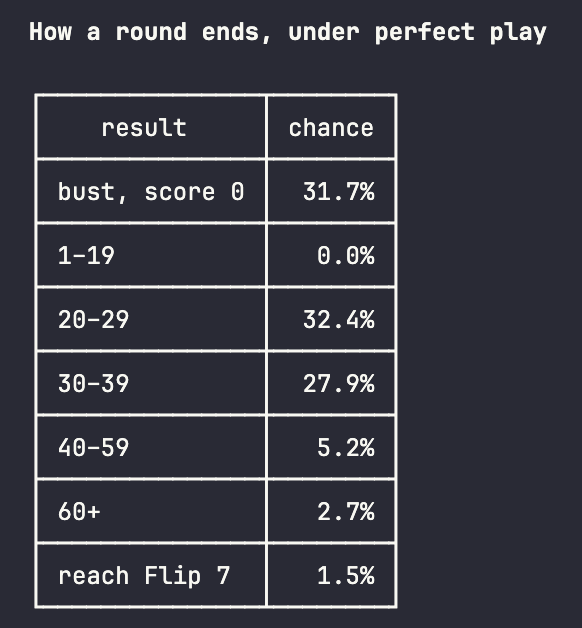
One round in such a solo simplified game, played perfectly, is worth on average 22.232 points. And in that perfect game, you busted 31.7% of the time. You reached a “Flip 7” (i.e., 7 cards face-up without busting) on 1.55% of rounds.
So a very simple rubric is: Hit on 22 and lower, Stand on 23+.
Now, this simulation using solo play strips out all kinds of factors, particularly other players giving you the bad cards precisely when you don’t want them.
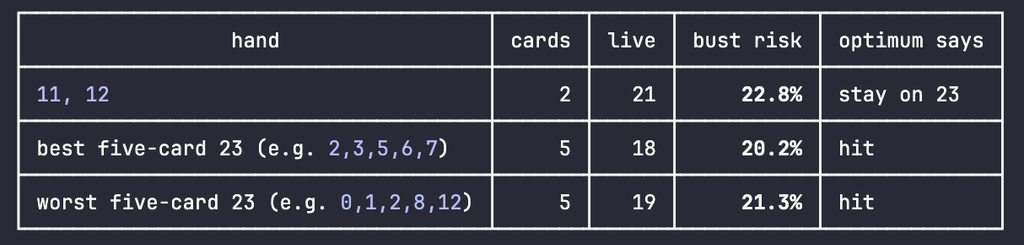
Importantly, such a simple rubric also collapses a six-card card 23 hand with a two-card hand of an 11 and 12.
Still, “hit on 22, stand on 23” is a good general rule outside of unusual conditions in the game.
The Odds of Busting on a 23
As every Flip 7 player knows, that the odds of busting a “23” vary greatly based upon how you’ve gotten to that 23. That is — the odds of busting with an (11, 12) hand are ALWAYS higher any other multi-card hand, because 11 and 12 are the most common cards in the deck. In fact, the odds of busting with an (11, 12) hand exceed every single one of the other 45 possibilities:
All play in Flip 7 is face-up, so in theory you could count cards, as long as you mentally keep track of the discarded ones from prior rounds.
So the slightly more intelligent modified rubric is…
Hit on a 22, stand on a 23, but go ahead and take another hit if you’ve gotten beyond 22 without drawing a highly common 12, 11, 10 or 9.
How much does perfect card-counting play actually buy you?
Only a few percentage points! This is the part I did not expect. I created a few game strategies (“policies”), then ran them in the simulation of 60,000 games.
The policies:
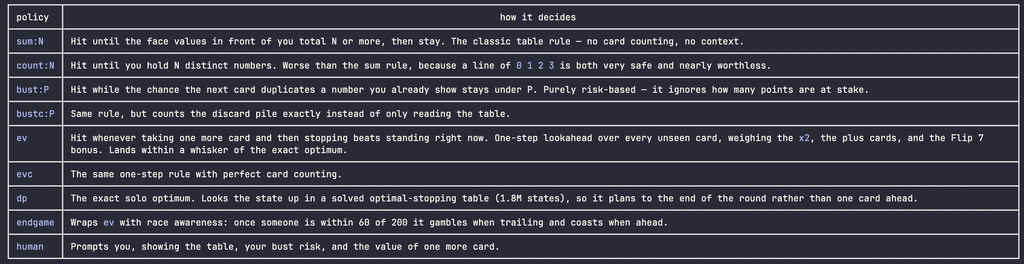
The expected value (EV), standard deviation (SD), bust percentage, and odds of getting the bonus “flipped 7 cards and got 15 more points” are shown in the table below:
policy                    EV      sd    bust   flip7
optimal               22.232   17.47   31.7%   1.55%
stand on sum 24       20.977   15.51   31.6%   0.01%
bust risk < 0.25      20.988   15.89   32.9%   0.03%
stand on sum 20       20.251   12.05   21.5%   0.00%
stand on 4 cards      19.669   18.58   43.0%   0.00%
stand on sum 16       18.559    8.92   13.7%   0.00%
bust risk < 0.45      14.058   24.71   73.8%   4.01%
Standing on a sum of 24 is worth 20.98. That is 94% of a solved 1.8-million state table, from a rule you can hold in your head while talking to someone.
Two things fall out of that table. Rules based on the sum of your cards beat rules based on the count of your cards, every time. A line of 0, 1, 2, 3 is very safe and nearly worthless, and a count rule cannot tell the difference.
And chasing Flip 7 on purpose is a trap. The policies that reach it most often are the worst policies in the list. Hitting at a 45% bust risk gets you the bonus 4% of the time and costs you 8 points a round to do it. The bonus is something you accept when it arrives, not something you play toward.
The rule
I wanted to know how simple I could go. So I took every state in the solved table, weighted it by how often it actually comes up in play, and asked: for a hand of this size, what single bust-risk cut-off loses the least value?
 numbers showing     hit while bust risk is under
               0                       always hit
               1                       always hit
               2                              22%
               3                              23%
               4                              24%
               5                              25%
               6                              34%
That is the whole thing. If you’re paying attention to the card count, you would optimally hit while the next card has under about a one-in-four chance of busting you. Push it to one-in-three when a single card would give you Flip 7.
It is worth 21.02 a round, within 5.5% of perfect play. Everything else the exact solution knows — which modifiers you hold, which particular numbers are showing, whether a Second Chance is still out there — is worth about one point a round between it, so it’s kind of not worth cluttering your brain with it.
Counting the bust risk in your head is easy, too. Add up the copies of the numbers you already show, and divide by the cards you have not seen. Showing an 11 and a 12? That is 11 elevens plus 12 twelves, so 23 dangerous cards out of the 92 you have not seen. Twenty-five percent, over the line for a two-card hand: stay.
Card counting optimizes, but not by too much
I built a bot that tracks the discard pile exactly and compared it to one that only reads what is face-up on the table.
Over 100,000 single rounds they scored the same to two decimal places: 20.21 each. That makes sense once you see it. At the start of a round the discard pile is nearly empty, so the table already tells you everything.
Across a full game to 200, where discards pile up between rounds, the counter gains about 0.2 points a round and roughly one percentage point of win rate. Real, but you would need a long night to feel it.
Optimal Strategy for Solo Play Gets Less Accurate with More Players
Here is where the optimal answer from solo play stops being the right answer. I ran a bot that maximises expected points against one that just keeps its bust risk under 25%. The risk-based bot scores less. Every run agrees on that: about 0.15 points a round less, consistently.
Then I varied one thing. How many people are at the table.
players   games     ev win%   bust:0.25 win%   ev pts/rd   bust pts/rd
      2  100,000       50.4%            49.6%       20.63         20.52
      4   60,000       24.5%            25.6%       20.90         20.73
      6   42,000       15.9%            17.4%       20.97         20.76
The mechanism is simple once you see it. To win a two-way race you need to be better than average. To win a six-way race you need a big score, and a policy that trades average for variance produces big scores more often. The bar rises with the size of the field.
Flipping 7 Should Award 25 Points
After a few rounds of play, we each agreed that the bonus for “flipping 7” (i.e., getting to 7 cards showing without “busting”) felt too low.
Welp, running thousands of simulations, it seems that intuition was right — simulation showed that it would be a much more balanced game if the bonus for “flipping 7” is more like 25 points. Luckily, it’s a game where you can make your own “House Rules,” and I’ll be adopting this one.
Github Repo
Want to explore this yourself? Check out the Flip7 Python Github Respository here: