
Washington State Income Tax: New Voters Guide Uses AI to Read the Tea Leaves on Judicial Candidates

A version of this story appeared today in Post Alley.
Earlier this year, Washington State passed an income tax, which many feel violates the Washington State Constitution and decades of precedent. While the so-called “millionaire tax” is at first limited to incomes over $1 million, if the Washington State Supreme Court decides it’s constitutional, there is nothing — zero — which prevents future legislatures from setting the income threshold to $0 by simple majority vote in Olympia, thereby applying an income tax to all Washingtonians, at whatever rates they’d like.
And there are very clear signs that it will be expanded to many more Washingtonians.
First, an amendment was put forward during the session to explicitly limit it to $1 million and up without sending changes to voters; Democrats voted that amendment down.
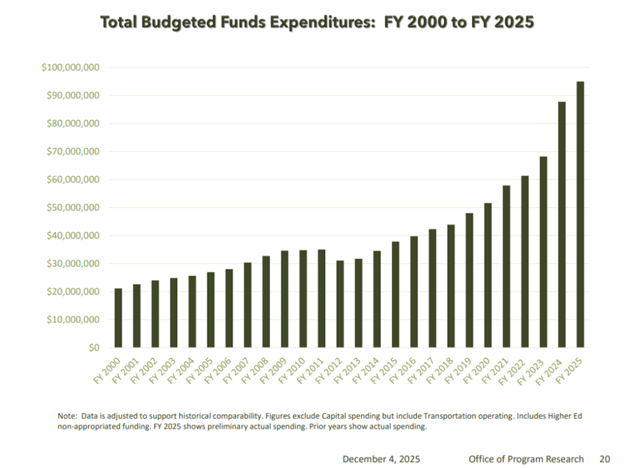
Second, the need for more and more revenue seems insatiable: despite two back-to-back record tax-hikes, Washington State is still running a massive deficit, with no sign of slowing down spending, nor getting a hold on clear signs of fraud.
Third, Governor Ferguson has already announced that 300 new staffers at the Washington State Department of Revenue are being hired, at a cost of more than $250 million per year. And fourth, you can read Jamie Pedersen’s own email communications, suggesting that this is only a first step in a broader strategy.
If you’re a voter opposed to this new income tax, as I am, the only good news is that the new income tax is actually on the ballot five times this year. That’s because five of the nine seats on the Washington State Supreme Court are up for election — first in the August 4th primary, which will narrow candidates down to two per seat, and then in the November 3rd General Election. And they will decide whether this income tax is constitutional.
But how do voters choose wisely?
A new voters’ guide, ChooseJudgesWisely.com, provides insight into how various Washington State Supreme Court candidates might rule. The site’s author, Viet Nguyen, used AI to try to forecast how each candidate might lean, based upon their past rulings and publicly available information.
What’s at Stake
The Washington State Supreme Court ruled in 1933 that income is property, and that an income tax is incompatible with the state constitution. This ruling, Culliton v. Chase, says income is property under the State Constitution’s Article VII. And it’s been the constitutional basis on which Washington has had no graduated income tax. But it will almost certainly be litigated in the next several months.
But first, how did the Culliton decision come about? In 1932, Washington voters approved Initiative 69, enacting a graduated state income tax with rates from 1% to 7%, to fund Depression-era public services. A Seattle insurance agent named William Culliton sued state tax commissioner Samuel Chase to block it, and in September 1933 the Washington Supreme Court ruled in Culliton’s favor, 5-4, that income is property under Article VII’s uniformity clause, which made any graduated tax rate unconstitutional.
Article VII says, “The word ‘property’ as used herein shall mean and include everything, whether tangible or intangible, subject to ownership.” It also says, “All taxes shall be uniform upon the same class of property.”
Since Culliton and all its subsequent affirmations consider income property, passing an income tax that charges different rates would be a clear violation of the state’s Constitution.
Voters have been very clear. We have rejected 10 income tax proposals since 1934, and lawmakers passed the voter Initiative 2111 in 2024, explicitly banning the practice.
Opponents of the new income tax want Culliton to stand. Proponents of a statewide income tax want Culliton overturned.
On the “Let’s have an income tax!” side, Senator Jamie Pedersen (D) of Seattle, lead sponsor of the new income tax, feels income is not property, and that the Culliton case was wrongly decided. Pedersen attempts to explain:
Opponents counter not only that the unconstitutionality of an income tax has been reaffirmed multiple times in Washington State, but wryly ask Pedersen that if income isn’t property, and carries no ownership, why can’t they have his?
Ultimately, their opinions on Culliton will not matter, nor will yours, nor mine. The question will be up to nine people; the justices seated on the Washington State Supreme Court. Four are already set, and some incumbents have been nominated by Governor Ferguson; voters can reasonbly assume that these judges will rule in his and Pedersen’s favor (or else they wouldn’t have been appointed.)
But voters do have a say, because in the next few months, we will decide who five of those nine justices will be, including whether we want to keep the justices Governor Ferguson has recently appointed.
Thus, the Washington State income tax itself, and all future versions of it, is on the ballot this August and November, five different times.
Most voters skip judicial races, but this election, we will crucially determine whether Washington State’s income tax stands or falls. So how can voters get more information on which way a candidate might rule?
New AI Tool Reads the Tea Leaves
Enter ChooseJudgesWisely.com. Washington tech professional Viet Q. Nguyen built this intriguing, free online tool that lets you read the tea leaves. The site includes a balance-of-power chart that forecasts how the court math might move under different scenarios.
How does it work? An AI agent scoured its knowledge of law and public statements, has ingested each of the sixteen candidates’ public records and rulings, and assigned one of three labels on the Culliton question: Are they likely to Keep the Culliton decision, Overturn it, or is there Not enough to guess?
Keeping the Culliton decision is great news for income tax opponents. It very likely means the income tax is thereby ruled unconstitutional. Overturning the Culliton decision almost certainly means a brand new income tax is the law of the land, and that the legislature can simply adjust rates and thresholds with a simple majority vote.
When I learned of this tool, I was fascinated. I reached out to Viet to discuss the site.

The balance chart shows six of nine current justices already leaning toward upholding an income tax.
About The Site & Author
Q: “Can you describe your day job and relevant background?”
I am the former President of 5G Americas, an international wireless trade association promoting cellular standards. We just wound down our operations, as the industry moves to 6G. In the tech/telecom side, I’ve worked in PR/communications at Microsoft’s worldwide commercial business – enterprise division and at T-Mobile corporate communications. In a former life, I’d worked in local politics for both Democrats and Republicans, as well as in government as a legislative staffer for King County Councilmember Reagan Dunn.
Q: “Why this question, why this election, why now?”
The state income tax is the most consequential issue for the State of Washington in a generation. For 93 years, Washingtonians have not had a state income tax. It’s part of our DNA. It’s as much intertwined with our identity as the rain and the mountains. This uniqueness is what attracts people to Washington State and is the reason why our corner of the country can bring in the best and brightest around the world.
Washingtonians don’t want to be just like any other state.
Q: How did you decide to narrow a Supreme Court voter guide down to a single issue?
It’s the issue I care most about. And I believe many other voters think the same way. It’s extremely hard to get good information about judicial candidates. They’re usually on the bottom of the ballot and have very little public presence. This is by design, as judges stay at arm’s length from politics.
In my previous life at a political consulting firm, we ran judicial candidates. It was an area where one party had lopsided advantages. And now, with decades of those advantages having played out, we stand at the precipice of trashing the only element in the Washington State Constitution that maintains a fundamental quality of life for our citizens – its ban on state income taxes.
Q: Let’s talk about funding, affiliations and independence. Anything readers should know about who paid for what?
This is a completely independent work. I paid for it myself. I have a terrible AI token addiction and might need to see a therapist if my AI spend continues at this rate.
Methodology
Q: What sources does the AI ingest for each candidate? Opinions, campaign sites, bar questionnaires, news interviews, oral arguments, something else?
I asked the AI to use a variety of different publicly-available sources. I asked it to make sure the sources were both accessible and validated, so that meant a reasonably high reputation. I didn’t provide it any guardrails on exactly the format of sources (oral arguments, etc), but I think it understood the assignment. There’s a lot of noise-to-signal, so it was important to try isolating the best sources of signal.
The more important thing was that it provides its rationale for rating candidates the way it did. Rating something is inherently a messy affair. There’s always room for error. So being transparent and up front about how something got rated, why it was rated that way, and admitting the size of the error bars, is important.
Always show your work.
Q: Which models are you using, and how much human review sits on top of the AI output before a label gets published?
Perplexity Computer uses an AI orchestrator that selects between 19 different leading models, depending on the assignment. It also has the ability to use model council, where multiple models can analyze data and synthesize output that better reduces outlier viewpoints.
In regard to human review, I exercised very little editorial opinion over how the AI assigned a label. I relied more on its published rationale to better understand the reasoning behind the rating.
Q: Where’s the line between “likely to” and “not enough to tell”? What does a borderline call look like in practice?
The AI makes the borderline call. It’s up to the human to judge whether that’s the right one. I created this site to provide humans more information about judicial candidates – not shortcut their thinking. I’ll leave it up to the political parties to spin this information however they see it, but voters deserve some reasonable semblance of thoughtful, spin-less analysis.
That’s why the rationale is included in the candidate pages.
Q: How do you handle candidates with thin records, like first-time judicial candidates or sitting judges with few published opinions on tax or Article VII questions?
There are a few questions that the AI provided at the bottom of the candidate pages, which help people elicit more signal from the candidates. Voters are encouraged to ask these questions from candidates to get a better read on how they’ll decide the case.
Additionally, there’s a comment/correction form on the site, so candidates or their campaigns (or anyone else really), can provide more information or detail. That triggers an email to me on the back-end, and I’ll do a bit of vetting before publishing changes to the site.
Q: “What’s the biggest known weakness in your method? Where would you bet you’re wrong?”
Probably AI hallucination. Lack of signal is always the number one problem. LLMs are very good at drawing some wild conclusions, so it’s very important to have world-class search functionality as part of any agentic AI workflow. Perplexity is known for having that incredible search functionality, so helps to mitigate the known weaknesses of LLM hallucination.
Q: “Has any candidate or campaign pushed back on their classification? What’s the correction process when they do?”
Not yet. The site hasn’t been up long enough. But I expect we’ll get some feedback. I always love getting lawyers mad at me. Especially if they’re Supreme Court justices.
There’s a correction form on the site. Candidates and their parties can reach out via that form. It emails me on the back-end. I review the request to make sure it’s not some spam or scam. If it looks like a legitimate request, then I’ll ask the AI to review the feedback and adjust the candidate page.
In parting, Viet said that he wants voters to thoughtfully consider the information, do more research on candidates, and share with friends.
Q: “Do you have your own stance on these candidates?”
Well, I can say that I will personally be voting against the candidates that want to tear down Culliton. On the site, those are coded amber. I’d hope people vote *against* those people. Vote *for* the people that have the blue dots.
I’m an independent, but that doesn’t mean I don’t have an opinion.
Election Day is August 4th for the Primary, and November 3rd, 2026. Voters can visit Culliton2026.org to explore the site and learn more.